
Ultrasonic Thickness Testing (UT) for Accurate Thickness Measurement and Flaw Detection
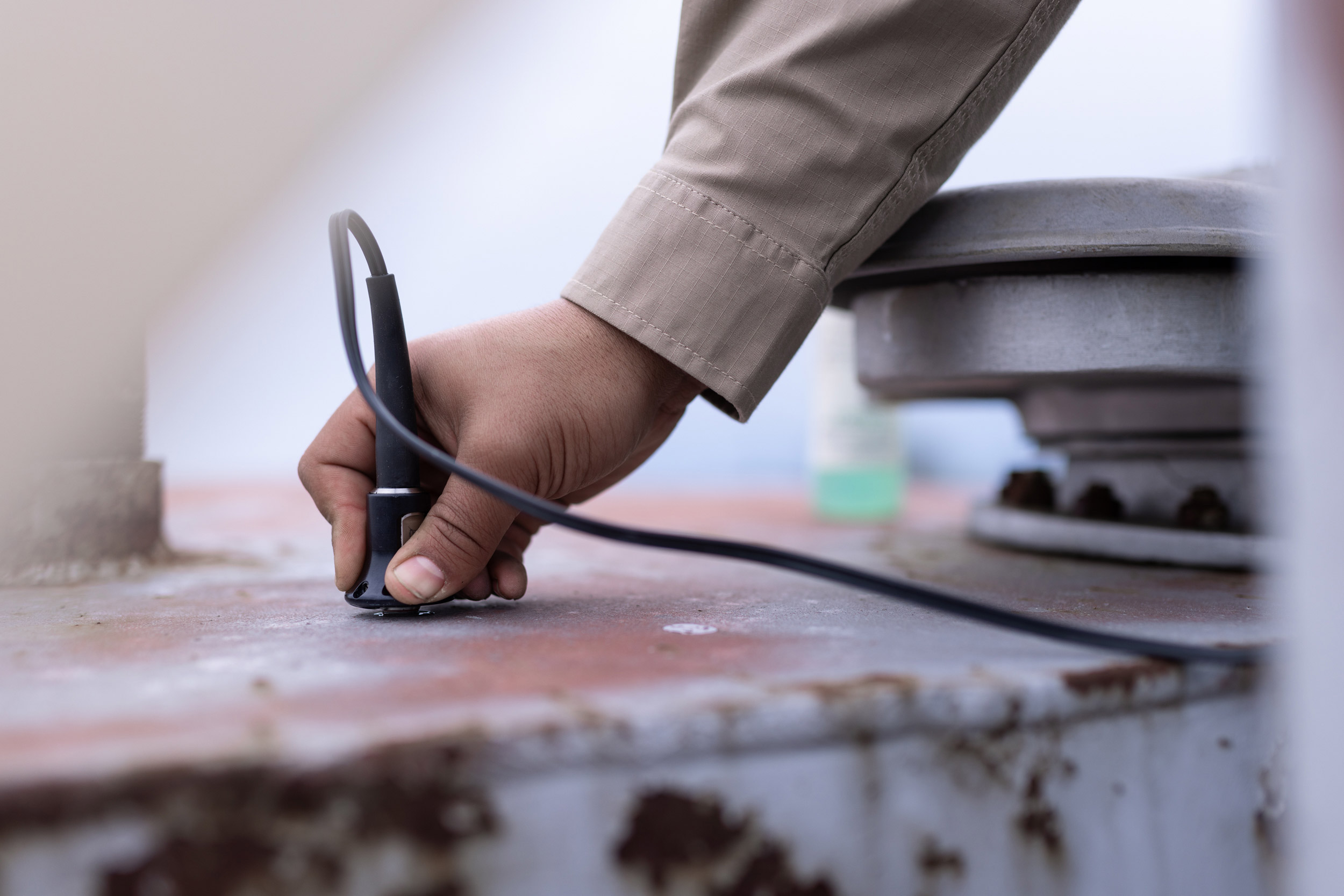
Ultrasonic Thickness Testing utilizes Ultrasonic Straight Beam and other ultrasonic NDT flaw detection techniques that employ sound energy during the testing process. This method is essential for NDT and Inspection services, providing accurate and reliable data for assessing material integrity.
Straight Beam
Straight Beam Testing operates on the principle that sound energy propagates through a medium until it either disperses or reflects off a boundary, such as air surrounding a far wall or a gap caused by a flaw. During testing, the operator pairs the transducer with the test piece and identifies the echo returning from the far wall (the ‘backwall signal’). Any additional echoes ahead of the backwall signal or shifts in the signal may indicate the presence of laminar cracks, voids, or other discontinuities. Further analysis determines the depth, size, and shape of the structure causing the reflection.
With its advanced capabilities, Ultrasonic Thickness Testing ensures compliance with ASME Code requirements and supports the needs of piping and vessel fabrication facilities, delivering reliable results for NDT and Inspection services.
Normal/Angle Beam
Normal beam testing introduces a sound beam at 90 degrees to the surface, ideal for thickness testing, while angle beam testing introduces the beam at an angle other than 90 degrees. The choice depends on the orientation of the discontinuities, as the sound beam should be as perpendicular as possible to the discontinuity’s primary axis for maximum reflection.
Need a Customized Inspection Solution?
Our team works closely with you to understand your challenges and deliver the right combination of services to meet your goals.