Advanced Inspection for Critical Asset Integrity

TOFD offers a reliable and efficient method of weld testing and defect sizing. A valuable complement to PAUT, TOFD is ideal for both pipeline integrity inspections and infrastructure inspections, delivering high accuracy and repeatability in assessing material and weld conditions.

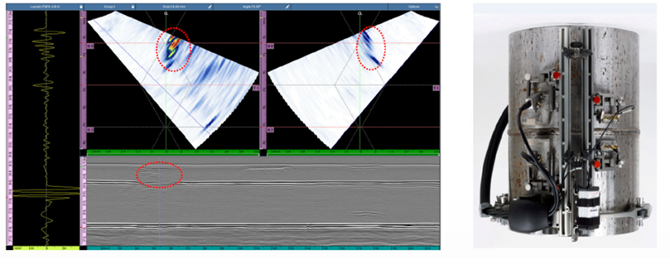
The Time of Flight Diffraction (TOFD) method uses a pair of angle-beam L-wave ultrasonic probes that are used in a pitch-catch configuration with the sound beam passing through the area of interest. A transmitter probe emits an ultrasonic pulse which is picked up by the receiver probe on the opposite side.

In an undamaged part, the signals picked up by the receiver probe are the result of multiple different wave energies that were generated by the transmitted beam: one that travels along the surface (lateral wave) and another L-wave that reflects off the inside surface (back-wall reflection), and one S-wave that reflects off the inside surface. When a discontinuity such as a crack is present, there is a diffraction of the ultrasonic sound wave from the top and bottom tips of the crack.

Using the measured time of flight of the transmitted and diffracted energy responses, the height and depth of the flaw can be calculated.
Applications & Capabilities

This ultrasonic UT testing method is commonly performed on welds, weld overlay cladding, piping, pressure vessels, storage tanks, and structural steel.
Read More
Fabricated vessels and piping can be thoroughly examined for fabrication flaws with Time of Flight Diffraction. Sizing of cracks and welding flaws can be done precisely using the TOFD UT testing method. Time of Flight Diffraction is also effective at measuring the remaining wall of a welded joint that has been damaged by preferential corrosion or root erosion.
Read Less

Advantages

TOFD provides highly accurate, repeatable weld inspection and flaw sizing, making it a valuable method for both new construction and in-service evaluations. Its speed, precision, and data consistency allow for reliable defect detection, monitoring, and long-term integrity assessment.
Read More
  • Flaw growth monitoring and wall thickness loss measurement
  • Effective identification of defects in both new construction and in-service inspections
  • Fast and efficient scanning of welded joints
  • Repeatable position and size data to track flaw growth and corrosion rates over time
  • Detection of in-service defects, including cracking, corrosion, and erosion
  • More effective measurement of wall loss at welded joints compared to angle-beam pulse-echo methods
Read Less

Applications

Applications for Time of Flight Diffraction:
Read More
  • Detecting cracking and sizing cracks as well as other planar defects, e.g. lack of fusion.
  • In-service defect monitoring and detecting manufacturing defects.
  • Weld examination – for pressure vessels, piping and storage tanks and spheres; in-service and new construction examinations.
  • Flaw growth monitoring and discrimination of defects between weld overlay, clad and base metal.
  • Measuring wall loss at welded joints damaged by preferential corrosion/root erosion.
Read Less

Limitations

Limitations of Time of Flight Diffraction include:
Read More
  • Weld must be accessible from both sides
  • Gathers and displays information in a way that requires experience to interpret
  • Not always code accepted as a stand-alone inspection technique
Read Less

Need a Customized Inspection Solution?

Our team works closely with you to understand your challenges and deliver the right combination of services to meet your goals.

XCEL
Privacy Overview

This website uses cookies so that we can provide you with the best user experience possible. Cookie information is stored in your browser and performs functions such as recognising you when you return to our website and helping our team to understand which sections of the website you find most interesting and useful.